AI Toolkit · For business owners
Five read-only prompts to check your AI-built app
Short answer Open your app in an AI coding tool and ask five read-only questions: what you store about people, which rules the builder assumed, what you would lose tonight, whether you would know it broke, and who else gets your data. In our test, each found a real gap.
If you built your app with Lovable, Bolt or another vibe-coding tool, you probably can't read its code. Your AI tool can, and it can explain the code to you in plain English without changing a line. You only have to ask the right questions, and tell it not to touch anything.
Our ten-minute data-leak check covered your database. These five prompts cover what it didn't. We tested each on a small booking app an AI model wrote for an imaginary dental clinic, the same app as in our prototype cliff experiment. Every prompt found something the clinic would want to know, from bookings allowed on Christmas Day to an appointment book with no backup in the app.
Before you start
Open your project in an AI coding tool such as Claude Code or Cursor, or use the chat in the tool that built it. Every prompt below starts with the same line: "Read only: do not change, run, install or deploy anything." These tools can edit your app, and here you want an answer, not a change. If your tool has a plan or chat mode that answers without editing, use it as well. In our test we let the tool edit files, and after all five prompts the app's files were unchanged. If the tool offers to fix something, say no for now and take the answer to whoever maintains the app. And if your project came to you as a download, read our .zip post before you open it in Claude Code or Cursor.
1. What do we store about people?
Read only: do not change, run, install or deploy anything. Explain in plain English for a business owner who does not code.

List every kind of personal information this app collects or stores (names, phone numbers, emails, addresses, payments, messages, health details).
For each one, say where it is stored, how long it is kept, and who can see it: the public, logged-in users, staff, or only the owner.
Answer as a table, then list anything you could not find out from the code.
Tested with Claude Code 2.1.285 (Claude Sonnet 5.5) on
A prompt is not an audit: AI review can miss problems, flag ones that aren't there, and answer differently each run. Don't point agents at code you don't trust; text hidden in it can steer them.
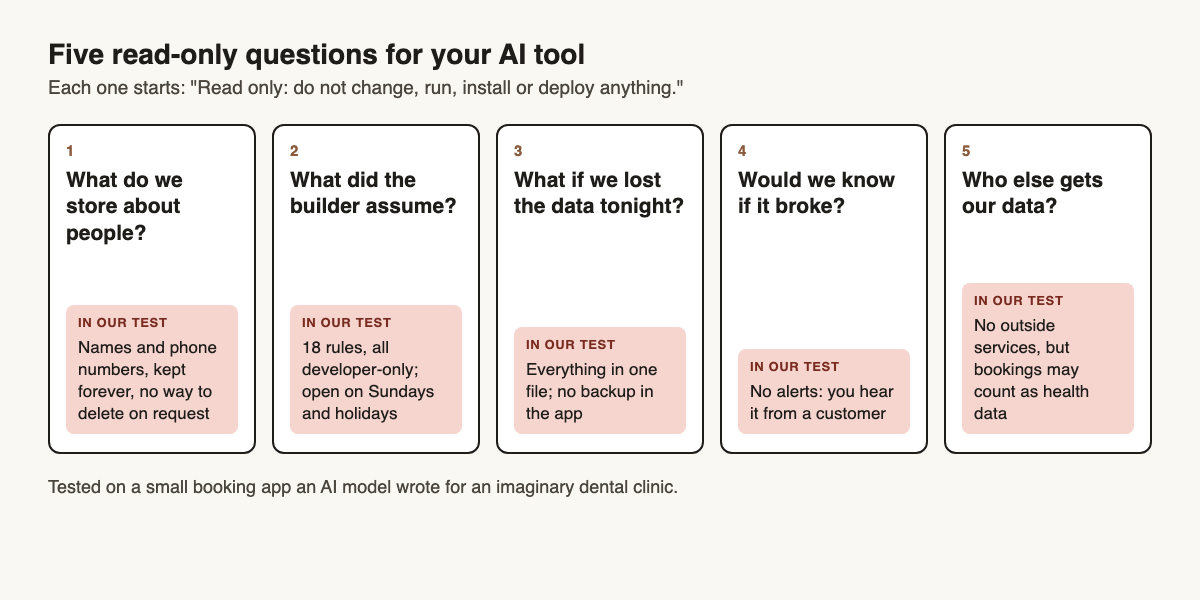
In our test, the answer showed that the app stores names and phone numbers in one file, keeps them forever even after a cancellation, and has no way to delete someone's data if they ask. It also noticed that a phone number works as the only "password", and that the clinic has no screen of its own to see the schedule.
2. What did the builder assume?
Read only: do not change, run, install or deploy anything. Explain in plain English for a business owner who does not code.

List every business rule this app assumes: opening days and hours, holidays, time zone, currency, prices, languages, limits per customer, and what counts as "today".
For each rule, say where it is in the code and whether it can be changed without a developer.
Then list rules a business like this usually needs that the app does not have.
Tested with Claude Code 2.1.285 (Claude Sonnet 5.5) on
A prompt is not an audit: AI review can miss problems, flag ones that aren't there, and answer differently each run. Don't point agents at code you don't trust; text hidden in it can steer them.
This one listed 18 rules and said none of them can be changed without a developer. Some are written into the code, such as opening hours, 30-minute slots and the computer's own clock used as the clinic's clock. Others are simply missing: every day is open, a customer can book on Christmas Day, and there is no limit on how far ahead someone can book. Then it listed what a clinic usually needs and the app lacked, from a cancellation deadline to a schedule the front desk can see.
3. What if we lost the data tonight?
Read only: do not change, run, install or deploy anything. Explain in plain English for a business owner who does not code.

Where does this app keep its data, and what would be lost if that machine or service disappeared tonight?
Is there any backup in the code or its settings? How would someone restore it, and how much would be lost?
Answer in five sentences or fewer, then list the questions I should ask my hosting provider.
Tested with Claude Code 2.1.285 (Claude Sonnet 5.5) on
A prompt is not an audit: AI review can miss problems, flag ones that aren't there, and answer differently each run. Don't point agents at code you don't trust; text hidden in it can steer them.
The answer: everything is in one file, and nothing in the app backs it up, so recovery depends entirely on the hosting company. Its ten questions for that company are worth sending as they are, including one that is easy to miss: can the disk be wiped when the app is updated or restarted?
4. Would we know if it broke?
Read only: do not change, run, install or deploy anything. Explain in plain English for a business owner who does not code.

If this app crashed or started returning errors at 2 a.m., who would find out, and how?
List what it logs, whether anything alerts a person, and what a customer would see.
Then list the three most likely ways it could fail in normal use, such as two customers acting at the same moment.
Tested with Claude Code 2.1.285 (Claude Sonnet 5.5) on
A prompt is not an audit: AI review can miss problems, flag ones that aren't there, and answer differently each run. Don't point agents at code you don't trust; text hidden in it can steer them.
"Almost certainly nobody until a customer complained or the front desk noticed in the morning." The app sends no alerts, and nothing in the app restarts it if it stops. The answer also caught a hidden failure: the app looks for its data file in whatever folder it is started from, so starting it from the wrong folder would quietly create a new, empty calendar, and every booking would seem to vanish.
5. Who else gets our data?
Read only: do not change, run, install or deploy anything. Explain in plain English for a business owner who does not code.

List every outside service, package or API this app uses, and for each one say what data it receives, whether it costs money, and where its key or password is kept (name the place only; never show the key itself).
Flag anything my privacy policy should mention, and anything that would stop working if the service changed its price or shut down.
Tested with Claude Code 2.1.285 (Claude Sonnet 5.5) on
A prompt is not an audit: AI review can miss problems, flag ones that aren't there, and answer differently each run. Don't point agents at code you don't trust; text hidden in it can steer them.
This app turned out to use no outside services at all: the code never contacts another company's server, so the data stays wherever the app is hosted. The answer also listed what a privacy policy should say, starting with the fact that a dental appointment can point to someone's health care, which many places treat as sensitive.
That last point is a legal one. Under the GDPR, "data concerning health" includes data about the provision of health care services that reveals information about a person's health statusSource 1, and similar rules exist elsewhere. Ask a lawyer whether it applies to you.
This is general information, not legal advice. Check with a lawyer for your situation.
What the answers can't tell you
An AI tool reads the code, not your hosting account, your contracts or what your staff actually do. In our test, most answers said what they could not see, such as how the app is hosted and whether the connection is encrypted. Answers vary a little from run to run, so treat them as a list of good questions, check anything important with a developer, and run the five prompts again after every big change to the app.
- You know what personal data the app stores and for how long
- The rules the builder assumed match how your business works
- There is a backup, and someone has restored it once
- Someone gets an alert when the app breaks
- Your privacy policy names every place your data goes
Next step
Get new posts as they come out
Every new post, in plain English and in depth. Follow the RSS feed.
Sources
- Art. 4 GDPR: Definitions (gdpr-info.eu). Retrieved . ↩