AI Employees, Safely · For business owners
Does your chatbot or AI receptionist have to say it's AI?
Short answer Yes, if it chats with people in the EU: it must say it's an AI from the first message, unless that's obvious. The EU AI Act puts the duty on whoever built the bot. Bought it? Check your vendor did it. Built or branded it? Add one sentence.
Call Smile Dental after hours and a friendly voice says, "Hi, this is Mia, how can I help?" Since 2 August 2026, under Article 50 of the EU AI ActSource 1, if that caller is in the EU, Mia has to say she's an AI.
You may have heard that every business with a chatbot must now add a disclaimer. The law is more precise than that. It puts the duty on whoever built the AI, and depending on how you got your AI receptionist, that may be your vendor or it may be you.
This is general information, not legal advice. Check with a lawyer for your situation.
The rule: say it's an AI in the first message
People must learn they are talking to an AI from the start of the first conversation, in a way that is clear, easy to notice, and works for people using screen readers or other assistive toolsSource 1. The Commission's guidelines say a disclosure only in your terms and conditions isn't enough on its ownSource 2. Calling the bot "your assistant" isn't enough either: the guidelines list generic references to "assistant" as unclearSource 2. Say AI. And whenever someone asks what it is, it has to tell themSource 2.
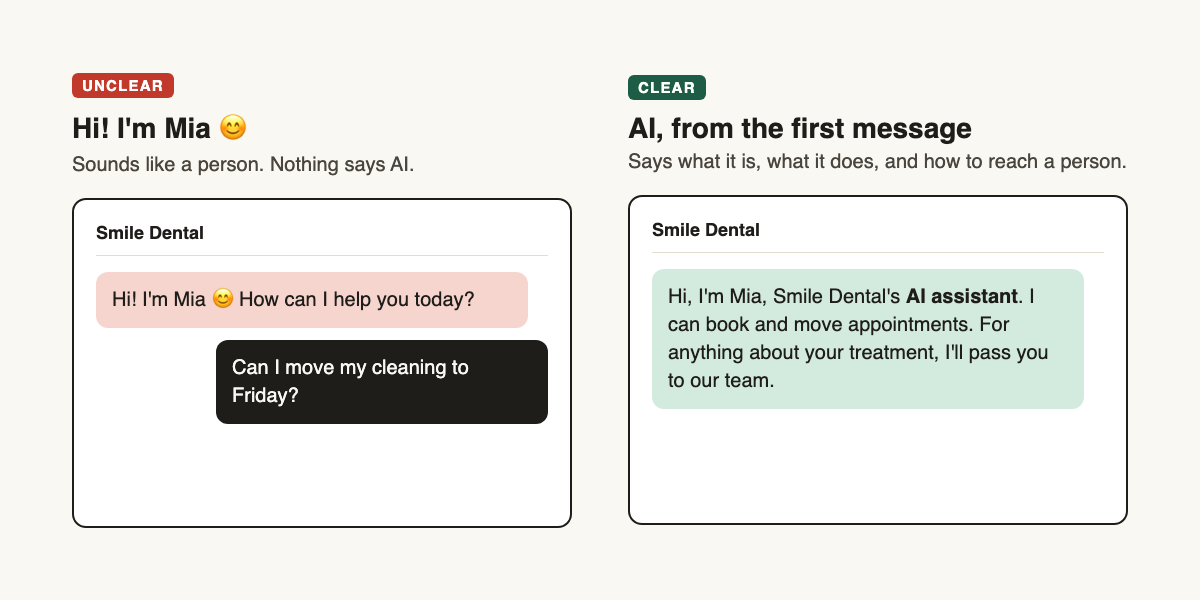
The one exception that matters to you: when it's obvious to a reasonably well-informed, observant person that they are talking to an AISource 1. The Commission says to read that exception narrowlySource 1. In our reading, a human first name and a friendly emoji won't pass that test.
AI your customers don't talk to directly is outside it
The duty applies when four things are true: it's an AI system, it's built for a genuine two-way exchange, the AI talks to the person directly, and the person is a human being. The Commission's guidance spells out the second and third: the system must be "designed for a genuine two-way exchange with people, rather than merely collecting data or providing automated responses"Source 1, and the AI must communicate itself "rather than through a human intermediary"Source 1.
So some common uses fall outside it, and some that look like they should, don't. An email your AI drafted is out when a person on your team actually reads and sends it; clicking send on an unread draft doesn't countSource 2. A reminder sent from a fixed template isn't AI at allSource 2, but if AI writes the reminder and answers the reply, it's in: an interaction can start with the AI, as long as it invites a responseSource 2. AI that works only in the background, such as a spam filter, is outSource 1Source 2. Your website chat, an AI that answers your phone, and an assistant inside your app are squarely in.
Your vendor's job or yours? It depends who built it
The AI Act calls the business responsible for building an AI system its provider: a business that develops an AI system, or has one developed, and sells it or puts it into service under its own name or trademarkSource 1. The duty to say "I'm an AI" sits with the provider, who must design the system so people are toldSource 1. (The Act calls a business that just uses an AI system a deployerSource 1.) For a provider that ignores the rule, fines can reach €15 million or 3% of worldwide turnover, and authorities can take a small firm's size into accountSource 1.
The rule also crosses borders. A provider outside the EU is covered when its AI's output is used in the EUSource 1. So a chatbot run from the US can be covered when it's offered to people in the EU, though one stray visitor from Paris shouldn't be enough on its ownSource 2. Either way, the duty lands on its provider: your vendor, or you if you built it.
That gives three situations.
You bought a ready-made AI receptionist
The company that makes it is the provider, so the disclosure is theirs to build. Your job is to check they did it: open your own chat or call your own number as a customer, and listen to the first thing it says. Most tools let you edit the greeting, so if you replaced the vendor's line, put "AI assistant" back in. If the vendor's own version doesn't say it, ask when it will, and keep their answer in writing.
You built it, or had it built
If you made the chatbot yourself with an AI tool, or a freelancer or agency built it for you, and it runs on your site under your name, you match the Act's definition of a providerSource 1. The disclosure is yours to add. It is usually one sentence in the greeting, and one at the start of a call.
You set up a vendor's bot under your own brand
Many tools let you name the assistant "Mia from Smile Dental" and hide the vendor. Whether that makes you the provider is a question for a lawyer. Our advice is simpler: act as if it's yours, and add the sentence. It costs nothing, and it's your name on the first message.
Two greetings you can copy
Say three things: that it's an AI, what it can do, and how to reach a person. The template: "Hi, I'm [name], [business]'s AI assistant. I can [task]. To reach a person, [how]."
- Chat: "Hi, I'm Mia, Smile Dental's AI assistant. I can book and move appointments. For anything about your treatment, I'll pass you to our team."
- Phone: "Hi, you've reached Smile Dental. I'm Mia, an AI assistant. I can book or move appointments. To talk to a person, say 'front desk' at any time."
Put it in the first message, every time. Keep the human path short and real: a disclosure that leads nowhere just frustrates people.
If you have customers in California
California has had a bot law since July 2019. It is unlawful to use a bot online to talk with someone in California while hiding that it's a bot, with intent to deceive them into a purchase or a vote. Saying it's a bot removes the liabilitySource 3, and the disclosure must be "clear, conspicuous, and reasonably designed" to inform peopleSource 3. Unlike the EU rule, it targets whoever uses the bot: your business. The law covers websites and appsSource 4; whether it reaches a phone line is unclear. The same first sentence covers both laws.
- The first chat message says "AI assistant" Not only your terms page or an icon.
- The first words of a call say it's an AI assistant
- Ask it "Are you a real person?" It says it's an AI.
- A person is one step away A word, a button or a number that works.
- Bought it? You heard the disclosure yourself And kept the vendor's answer in writing.
- Built it or branded it? You added the sentence yourself
Next step
Get new posts as they come out
Every new post, in plain English and in depth. Follow the RSS feed.
Sources
- Transparency obligations under Article 50 of the AI Act (European Commission FAQ, updated 24 July 2026). Retrieved . ↩ ↩ ↩ ↩ ↩ ↩ ↩ ↩ ↩ ↩ ↩ ↩ ↩
- Commission Guidelines on the transparency obligations of Article 50 of the AI Act, C(2026) 5054 final, Annex (20 July 2026). Retrieved . ↩ ↩ ↩ ↩ ↩ ↩ ↩ ↩
- California Business and Professions Code §17941 (SB 1001). Retrieved . ↩ ↩
- California Business and Professions Code §17940 (definitions). Retrieved . ↩